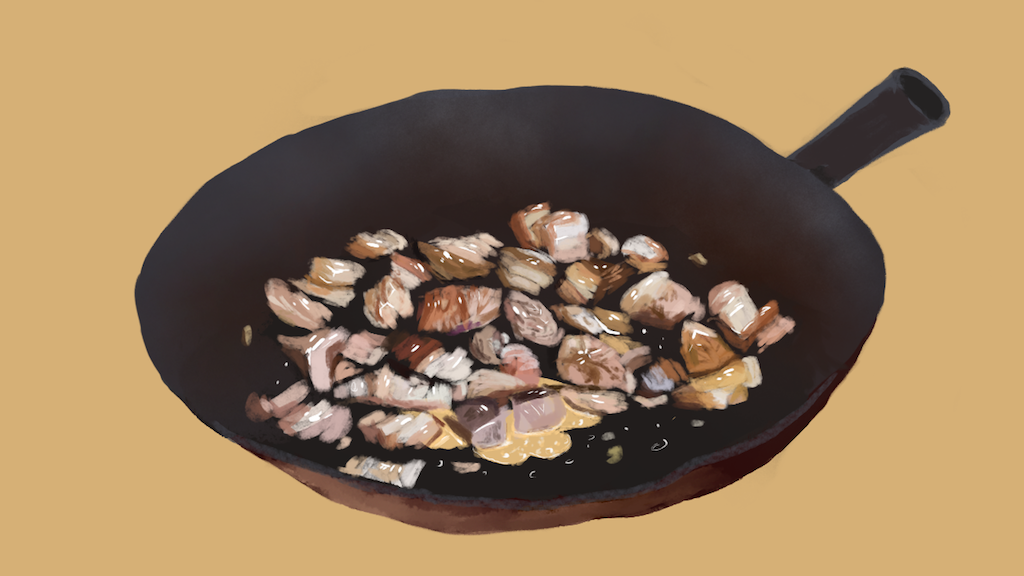
Fusion technique
in cooking has been a norm in Filipino kitchen long before Ferdinand
Magellan discovered the Philippines in 1521. One may note that while
“fusion” has just been popularized by the elite group of modern chefs,
and dubbed by some as “East Meet West,” the original concept was
introduced to and adopted by Filipinos as a result of migration and
colonization.
It goes back to about 20,000 years ago. The Ice Age
reduced the levels of the oceans creating bridges between landmasses,
making migration possible. The Malays were the first inhabitants of the
Philippine Island. The Malay influence can be found in popular dishes
such as :


The
Arabs were already settled in the islands in considerable numbers before
the Spanish arrived. Chinese, Japanese and Hindus had permanent
settlements, as well. The Japanese introduced Halo-halo.

Kare-Kare (a meat and vegetable stew in peanut sauce)

Pinakbet (another meat and vegetable stew flavored with shrimp paste),
and Dinuguan
(a stew made from pork meat and blood, spiced with chili peppers).

CTTO
Chinese
traders sailed across the South China Sea around 300 AD, and by the
year 1000, trading was taking place on a regular basis with the coastal
ports and colonies that the Chinese had established. By 1400, they had
made their way inland and become established as part of Philippine
culture. Their contribution to Filipino cooking reflect in noodle dishes
called Pancit, steamed dumplings like Siopao, Siomai, Pancit Molo,


CTTO
and varieties of eggrolls, fried or fresh called Lumpia.
The
Philippines was already engaged in a thriving cultural and commercial
exchange with China, Indonesia, Thailand and Malaysia before the
Spaniards arrived. The colonists found a culture whose family structure,
diet, outlook and language was already formulated within the Asian
context.
Ferdinand Magellan claimed Philippines in the name of
Spain and the ruler at that time, King Philip, and thus begun 400 years
of Spanish influence and domination. History stated that in the
sixteenth century, Pope Alexander VI, in an effort to quell the feuding
between the major world powers, — at this time, Spain and Portugal
-–took a map of the known world and drew a line down the middle of the
Atlantic Ocean. All that lay east of the line was given to Portugal and
all that lay west of the line was given to Spain. Portugal sphere and
influence encompassed the eastern-most tip of South America – what is
now part of Brazil – all of Africa, and eastern Asia. Spain’s influence
extended to most of South America, all of North and Central America and
most of the land bordering on the Pacific Ocean including the
Philippines. Further, historians also noted that although Spain received
more land, it was most unexplored, while Portugal gained control of
trade routes and bases that were already established. This division of
the world explains why the people of Brazil speak Portuguese while the
rest of South America speaks Spanish. Although the Philippines is part
of Asia, Filipino language and its regional ethnic dialects are heavily
studded with Spanish words and phrases.
About 80% of the dishes
prepared in Filipino kitchen today can be traced to Spain. The Spaniards introduced tomatoes and garlic along with the technique of sautéing
them with onions in olive oil. Add to that, as in popular baked good and
desserts like


 Most Spanish recipes had been modified to accommodate what were readily
available re ingredients. Thus, the emergence of a cuisine Filipinos
called their own, adapted to their tastes.
Most Spanish recipes had been modified to accommodate what were readily
available re ingredients. Thus, the emergence of a cuisine Filipinos
called their own, adapted to their tastes.
Pan de Sal (a crusty dinner roll),
Flan (an egg custard),
Ensaymada (cheese buns),

rice dishes as in Arroz Valenciana or Arroz Con Pollo, etc.
Spain managed the
Philippines through Mexico for more than two hundred years. The Manila
Galleons plied the waters between Acapulco and Manila, heavily laden
with goods and treasures from Asia and Europe. Through Mexico, Filipinos
were introduced to the use of bay leaves and annatto seeds (also known
as atsuete or achote). Evidence to this influence can be found in


Adobo (braised pork or chicken in vinegar and salt or soy sauce),

Menudo (pork and liver stew).
The Dutch also made several forays into Philippine waters throughout the 17th
century only to be repelled by the Spanish Armada. Britain occupied
Manila briefly in 1762 and left behind Indian deserters who migrated up
the Pasig River, made settlements along the way and intermarried with
the Malays.
By 1890, the Spanish-American War erupted and the once
Spanish-held possessions, including the Philippines became American
territories. Filipinos were introduced to potato and macaroni salads,
baked fruit pies and more recently, fast foods such as hamburgers,
french fries and pizza. In the aftermath of World War II, Filipinos were
introduced to canned goods. Fruit salad was born using canned fruits
(drained) mixed with native sweets like buko (fresh young shredded coconut), kaong (palm nuts) and bits of langka (jackfruit)
mixed with Nestle cream or condensed milk and cream cheese, top with
cherries and served chilled on a bed of lettuce for presentation.

The
most significant American influence to the Filipinos has been the
English language. No one could have expressed this more eloquently than
Stanley Karnow, journalist and historian, in his book titled “In Our
Image,” America’s Empire in the Philippines. “America conquered the
Filipino nationalists in a cruel conflict and then, infused with
missionary zeal, sought to remake the Philippines “in our image” –
complete with American political, educational and cultural institutions.
The American imprints remains but it has barely altered traditional
Filipino values. During its half century of colonial tutelage, American
had endowed the Filipinos with universal education, a common language,
public hygiene, roads, bridges, and, above all, republican
institutions.” As a former foreign correspondent covering Asia, Stanley
Karnow found that the Philippines differed drastically from any other
region he visited or from any other places he previously covered like
Europe, Africa or the Middle East. He found Filipinos to be very
familiar with Americans, most spoke Americanized English and many had
been educated in the United States or in American Schools. “They knew
far more about the United States than I knew about the Philippines, as
if they were some kind of lost American tribe that had somehow became
detached from the U.S. mainland and floated across the Pacific.”
There
has been an influx of Filipinos going to Japan and Germany as contract
professionals, entertainers and laborers. Likewise, Japanese and German
tourists visit the Philippines. Sushi bars emerged together with
tempura and noodle bowls. Filipinos found a kindred spirit with Germans
in their use of vinegar, spices and salt. German sauerkraut has a cousin
in Filipino Atsara (shredded green papaya).


As
in metamorphosis, and for as long as Filipinos adhere and practice its
tradition called “Filipino Hospitality,” its cuisine will continually
change as it takes the best from those cultures and adapting them to the
Filipino taste.
– Shared in November 2001 by a Filipino sous chef who remains anonymous.
Source: https://www.aboutfilipinofood.com/fusion-philippine-cuisine/